A Battery Is Not a Power Source: What Storage Actually Does
Battery storage shifts electricity from charging time to use time; learn what charging, discharging, and energy losses mean for everyday devices.
Your phone sits on a charger while you make breakfast, then runs untethered on the bus. That small routine captures the central idea of battery storage: electricity is supplied at one time, held in another form, and returned later. A battery is not a source that creates energy; it is a store that lets us use energy after the original supply has moved on.
Storage moves energy through time
A power source supplies energy by converting it from another form or drawing it from a continuing supply. A generator may convert motion into electricity; a solar panel converts sunlight. A battery instead accepts electrical energy during charging and stores it as chemical energy. During discharge, chemical reactions make electrical energy available to a connected device.
That distinction is easy to miss because the battery can feel like the source when you press a button and a lamp comes on. In that moment, it is the immediate supplier of electricity. But the energy in the battery came from somewhere else: a wall outlet, a vehicle charging system, or a solar setup, for example. Calling it a source in everyday speech is understandable; describing its role precisely helps explain what happens before and after use.
Storage changes timing, not origin. It can make energy available when the original supply is absent or inconvenient, but it cannot provide an endless stream. Once the stored energy has been used, the battery needs another supply to charge it again.
Charging and discharging are different directions
During charging, an external supply pushes electrical energy into the battery. The battery’s internal chemistry changes as it stores that energy. During discharging, the chemical process runs in the direction that sends electrical energy back through the circuit. The two processes are linked, but they are not perfect mirror images: some energy is lost as heat, and the battery’s condition and design affect how it behaves.
The terms can be made concrete without opening anything. A rechargeable flashlight connected to its charger is charging; once unplugged and switched on, it is discharging. A phone’s battery icon gives a rough indication of stored charge, while the cable shows that an external supply is connected. The icon is a useful everyday clue, not a direct view of the battery’s chemistry.
Not every battery is designed to be recharged. Disposable alkaline cells are intended to deliver stored chemical energy once, while rechargeable lithium-ion and nickel-metal hydride batteries are made for repeated charging and discharging under suitable conditions. Use the battery type and charging equipment specified for the device; labels and manufacturer instructions matter because chemistries and designs differ.
Stored energy and power answer different questions
Energy describes how much electrical work a battery can supply over time. Power describes how quickly it can supply it. A small battery may run a low-power clock for a long while but struggle to operate a device that asks for a strong burst of power. A battery’s size alone does not tell you how well it suits every load.
For consumer devices, capacity labels help compare how much energy batteries can hold, while voltage and current ratings relate to the electrical conditions a device needs. The relevant label depends on the product. A camera, cordless tool, or portable speaker may have different demands, so matching the battery to the device matters more than choosing the largest-looking pack.
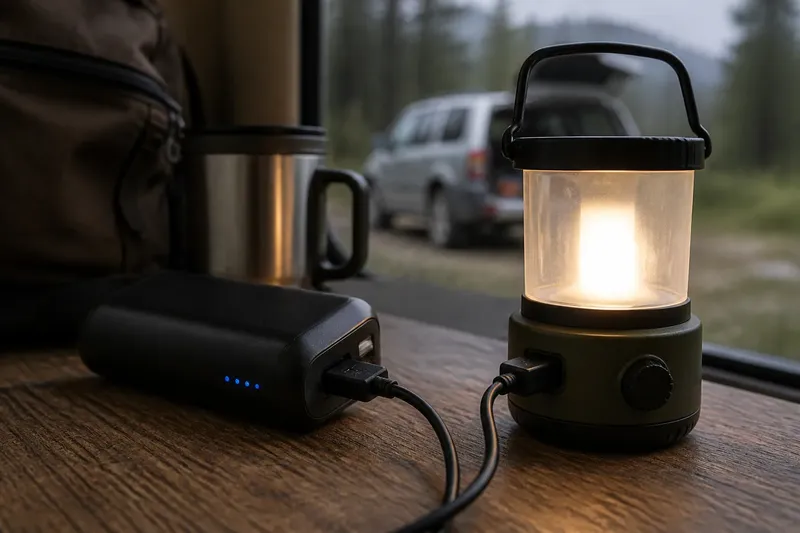
Imagine a camper who charges a lantern’s rechargeable battery from a car outlet before a trip, then uses the lantern at a campsite without a convenient outlet. The car’s electrical system supplied the energy during charging; the battery stored part of it, with some lost along the way, and later delivered electricity to the lamp. When the lantern dims or stops, that does not mean the battery has made energy vanish. It means the available stored energy has fallen too low for the lamp to operate as intended.
Why does a battery run down?
What happens when the battery reaches its limit?
As a battery discharges, its stored chemical energy becomes less available for electrical output. A device may slow, dim, or shut off when the battery can no longer meet its operating needs. The battery has not become a new energy source by being used; it has delivered some of the energy it previously stored.
Why does charging take longer than a quick burst of use?
Charging is limited by the battery’s design, the charger, and the device’s controls. A charger cannot simply force energy in at any rate without regard to the battery’s needs, so charging behavior may change as the battery fills. Use the compatible charger and follow the product’s directions rather than treating every cable or power adapter as interchangeable.
Does a battery return all the energy put into it?
No storage process returns every bit of the energy supplied. Some energy is lost during charging, stored energy may be lost while the battery sits, and more is dissipated during discharge. The amount and pattern depend on the battery and conditions, so a battery is best understood as a useful energy buffer rather than a perfect container.
Can a battery keep powering something indefinitely?
No. A battery can supply energy only while it has usable stored energy, and it must be recharged from an outside supply if it is rechargeable. A device that runs continuously from a battery still depends on the energy source that charged it, even if that source is out of sight.
Storage helps balance supply and demand
At a larger scale, batteries can hold electricity when it is available and return it when demand or supply conditions change. This does not make them generators. They shift some energy from one moment to another, which can help a system use electricity more flexibly. The same basic logic appears in a small power bank and a large grid-connected battery, even though their equipment and operating roles differ.
Storage also has limits that a simple “charge now, use later” description can hide. Batteries have finite capacity, conversion losses, and a maximum rate at which they can accept or deliver energy. A system needs an original supply to charge them, and the timing of that supply matters. Storage can help bridge a gap; it cannot erase the need to produce or obtain energy in the first place.
That is why a battery’s contribution is easiest to understand by asking two questions: where did its charging energy come from, and when will the stored energy be used? Those questions keep the source and the store distinct without diminishing either role. The source supplies energy; the battery makes some of that supply available at a different time.
Read the battery as a link, not an origin
When a device works unplugged, the battery is the immediate reason electricity reaches its components. Trace the chain one step further, though, and the battery becomes a link: an external supply charged it, its chemistry held energy, and a circuit now delivers that energy to the load. This simple mental model applies whether the battery is tucked inside a phone or installed in a larger storage system.
For everyday energy literacy, the useful distinction is straightforward: generation creates an electrical supply by converting energy from another form, while storage saves some supplied energy for later use. Next time a battery powers a quiet device, notice the moment it was charged and the moment it is doing work. The gap between those moments is exactly what storage is for.