From Sunlight to Socket: The Stages Behind Rooftop Solar
Rooftop solar turns sunlight into usable building electricity through a chain of conversion, control and connection. Follow what happens at each stage.
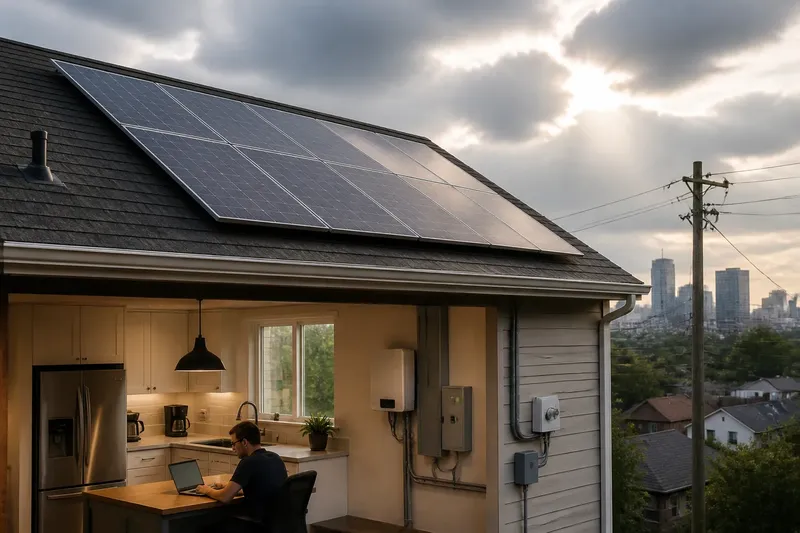
A patch of sunlight crosses a roof while a refrigerator hums in the kitchen below. Rooftop solar electricity connects those ordinary moments through several stages: sunlight reaches solar cells, the cells produce direct current, equipment converts and manages that electricity, and the building’s circuits deliver it to appliances.
How does sunlight become electricity in a solar panel?
Sunlight becomes electricity when light transfers energy to a solar cell’s electrical charge carriers. Most rooftop panels use photovoltaic cells, commonly made from semiconductor materials such as silicon. The word photovoltaic describes this conversion of light into electrical energy.
A cell’s material and internal structure allow light to set electrons in motion in a preferred direction. Electrical contacts collect that movement, creating direct current, or DC. In direct current, electric charge flows in one direction through a circuit.
A panel contains connected cells protected beneath glass and other layers. Several panels linked together make an array. The amount of electricity produced changes with the sunlight reaching the cells: cloud cover, shade, the sun’s position and the panel’s orientation all affect the available output. The panels do not store sunlight for later; they convert the light that reaches them into electricity at that moment.
What do solar panels produce on a cloudy day?
Solar panels can produce electricity under cloud cover, but the output generally changes as less sunlight reaches them. A bright, clear sky is not a requirement for photovoltaic cells to work; direct sunlight is simply a stronger source of light than diffuse light scattered through clouds.
Shade can also matter, especially when it falls across part of an array. How much it affects the overall output depends on the system’s electrical design and which panels are shaded. A small patch of shade on one section does not necessarily mean every panel stops producing, but the array’s behavior cannot be inferred from the shaded area alone.
At night, panels receive no sunlight and therefore do not generate solar electricity. A building can still receive electricity through its connection to the utility network, or from an appropriately configured stored-energy system. Those are separate sources; the panels themselves are not producing power in darkness.
Why does rooftop solar need an inverter?
Rooftop solar needs an inverter because panels produce DC electricity, while the building’s ordinary circuits and the utility network use alternating current, or AC. AC changes direction repeatedly. The inverter converts the panels’ DC output into AC in a form that can serve compatible building loads or connect with the network.
An inverter also adjusts how the panels operate as sunlight changes. Solar-cell output is not a fixed stream: available light and electrical conditions shift throughout the day. The inverter’s controls help draw usable power from the array while operating within the system’s electrical limits.
Different systems may use a central string inverter connected to groups of panels, or smaller inverters associated with individual panels or sections. These arrangements affect how the system responds to differing panel conditions, but the underlying role remains conversion and control. The particular equipment and its approved operating conditions depend on the product and system design.
How does solar electricity reach a wall outlet?
Solar electricity reaches a wall outlet through the building’s electrical distribution system. After an inverter converts the panel output to AC, the system connects with the building’s electrical circuits. Those circuits carry power through wiring and protective equipment to outlets, lights and other connected loads.
In a grid-connected building, solar power can serve active electrical loads while the building remains connected to the utility network. If the panels produce less than the building is using, the network can supply the difference. If solar production exceeds the building’s immediate use, the extra electricity may flow toward the network, subject to the system arrangement and local rules.
Imagine a small office with rooftop panels producing more electricity than its lights and computer are using at midday. The extra output could flow outward through the building’s grid connection; later, when the office needs more than its panels provide, electricity could flow inward from the network. The observable point is that the building stays supplied through a connected system, while the direction and balance of power change with generation and use.
A meter records electrical exchange according to its design and the applicable billing arrangement. It does not create or convert the electricity. The inverter, building circuits and network connection each have distinct jobs, even though their operation is coordinated as part of one system.
What happens when solar panels make more electricity than a building uses?
When solar production exceeds the building’s immediate demand, the surplus may be exported to the utility network if the system is configured and authorized for that operation. In other arrangements, equipment may limit export or direct surplus toward an available storage system. Excess generation is not automatically stored: storage requires separate equipment and controls.
Export arrangements and how exported electricity is treated vary with the utility, system configuration and local rules. A solar array’s output and a household’s bill are related, but they are not the same thing. Billing can depend on when electricity is used, how the meter records flows and the terms that apply to the connection.
Does rooftop solar work during a power outage?
A typical grid-connected solar system shuts down during a utility outage unless it has equipment designed to provide backup power. This behavior helps prevent the system from sending electricity onto network lines while utility crews may be working on them. Panels receiving sunlight do not, by themselves, make a building’s outlets available during an outage.
Backup operation requires a system designed to separate selected building circuits from the utility network and manage the available supply. Some systems can provide backup through a compatible inverter and other controls, while others are intended only to operate when the grid is present. The details depend on the equipment and system design; a qualified solar or electrical professional can explain a particular system’s capabilities.
Why does rooftop solar output change from hour to hour?
Rooftop solar output changes because the light reaching the panels changes. The sun’s position shifts, clouds pass, and nearby objects may cast moving shadows. Panel temperature and the electrical system’s operating conditions can also influence output.
That variation is normal for a source tied to daylight. A smooth curve on a monitoring display can become uneven when clouds cross the array; a drop after sunset reflects the end of sunlight, not necessarily a fault. Monitoring equipment reports information about production, but a single reading needs context such as time of day, weather and system status.
The conversion chain is easiest to understand as a sequence of roles: cells turn light into DC, an inverter converts and manages that output, and building circuits or the utility connection carry the resulting AC where it can be used. For rooftop solar, that distinction helps answer the practical question behind the technology: sunlight becomes useful building electricity only through the equipment and electrical pathways that connect generation to demand.